The music behind the concert
What is klezmer? Tunes, dances and history
Where the word klezmer comes from, what klezmer bands played at weddings, how the instruments changed and how the music came back after the Holocaust.
Reserve a seat for the concert ↗A word for the instruments, then the players
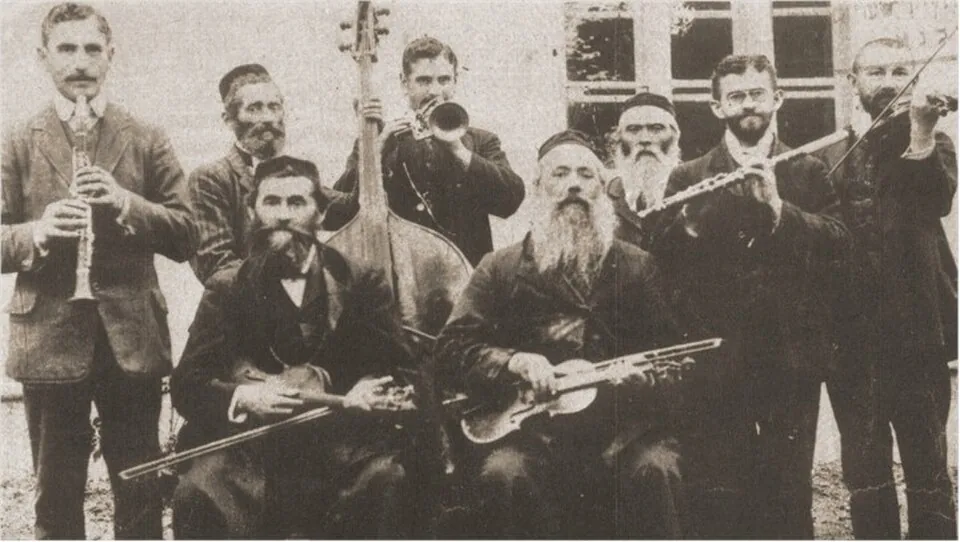
In Yiddish the word klezmer comes from Hebrew: klei meaning instruments and zemer meaning melody. Over time it came to name the musicians instead of the instruments, first in Bohemia in the second half of the sixteenth century and then in Poland. The shift may reflect the new status of the players, who were forming professional guilds. Only in the late twentieth century did English speakers start using klezmer for a genre of music.
The 1595 record
The earliest written use of the word that a scholar, Isaac Rivkind, has identified comes from a Jewish council meeting in Kraków in 1595. Musicians may have existed earlier in Prague, where references go back to 1511 and 1533. In the 1600s the situation of Jewish musicians in Poland improved, because they gained the right to form guilds, set their own fees and hire Christian players.
Weddings first
A klezmer's main work was the wedding, and the repertoire was tied to its stages: music for dances, and music for listening at the table or in processions. Few klezmer musicians before the late nineteenth century had conservatory training. They learned by apprenticeship. The rise of Hasidic Judaism from the late eighteenth century also fed the music, because Hasidim stressed dancing and wordless melodies as part of Jewish practice.
The dances
Klezmer dance tunes served circle dances and figure dances at weddings, and several of the forms still appear in concerts today, so it helps to know their names. The simplest tune is the one for the circle, and the most dignified is the one named after the Hasidim. Here are four to listen for when the ensemble moves from a slow piece to something you could dance to:
- Freylekhs: the simplest, most widespread circle-dance tune
- Bulgar: a syncopated circle dance from Moldavia
- Sher: a figure dance for four couples, named for scissors
- Khosidl: a more dignified dance named after Hasidic Jews
Listening music
Not everything was for dancing. The best-known listening form is the doina, a non-metrical, semi-improvised piece borrowed from Romanian music. A terkisher is a virtuosic solo in an Ottoman or oriental style. Table tunes and processional melodies filled other moments of the wedding day. This mixture explains why a klezmer concert can move from a slow, sighing solo to a fast circle dance within minutes.
Instruments and bands
Eighteenth- and early nineteenth-century klezmer bands were small, roughly three to five players on woodwind or strings. A common line-up was a lead violinist, a second violin, a cello and a cimbalom. The clarinet joined those small ensembles in the mid-nineteenth century and now often carries the melody. In Ukraine, larger orchestras of seven to twelve players, with brass, grew up by the end of the century.
A style of sighs and laughs
Klezmer is more than a set of tunes. Players imitate the sighing and laughing of cantorial and Hasidic singing, with ornaments that have Yiddish names, such as krekhts, meaning a groan. Vibrato is used sparingly and treated as one more ornament. Listen for those bent notes and slides, because they are what separates klezmer from a folk dance played straight.
The sound of the scale
Many klezmer tunes use the Freygish scale, a mode with a flat second and a raised third. The collector Moisei Beregovsky estimated that roughly a quarter of the klezmer music he gathered was in Freygish, and Wikipedia lists Hava Nagila among the best-known pieces in it. Other tunes sit in minor keys, which Beregovsky found in most of the repertoire. Together these give klezmer its blend of sweetness and ache.
Klezmer in America
Klezmer musicians followed the great waves of Jewish emigration to the United States from the 1880s, and in the 1910s and 1920s their bands made recordings. Clarinetists such as Naftule Brandwein, who came from Galicia, and Dave Tarras became celebrities. The Immigration Act of 1924 and the Depression then shrank the market for the large klezmer orchestras, and the music fell out of fashion for decades.
Revival
After the destruction of Jewish life in Eastern Europe in the Holocaust, klezmer lost much of its audience. It was revived in the United States from the late 1970s. By the 1980s and 1990s the revival had spread to Europe and inspired new interest in places such as Germany, France, Poland and Russia. In Kraków, a festival of Jewish culture has been held since 1988, and the guide to klezmer in Poland on this site tells that story.
Read next: Klezmer in Poland today
Sources